-
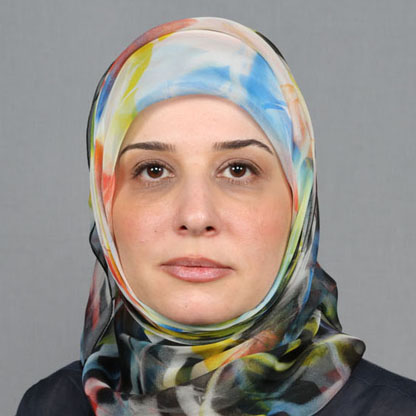
Dunia Al Hadi
- Lecturer
- Ext: --
Dr. Dunia Al Hadi is a specialist dentist and lecturer in Restorative Dentistry, with extensive clinical experience in various dental disciplines, particularly in Endodontics. She joined Ajman University (AU) in 2003 and has since been involved in teaching a variety of courses. She has served as the coordinator for Clinical Dentistry, a college representative for student affairs, and a member of the college's examination committee. Currently, Dr. Alhadi is a lecturer and clinical supervisor for undergraduate and internship students, as well as a research supervisor for students' graduation projects.
Education
- Fellowship in Endodontics, MHG, Dubai, UAE, 2018
- MFDS RCS, The Royal College of Surgeons of Edinburgh, UK, 2002
- M. Dent. Sc, University of Leeds, UK, 1999
- B.D.S, Baghdad University, Iraq, 1993
Fellowship in Endodontics, MHG, Dubai, UAE, 2018
MFDS RCS, The Royal College of Surgeons of Edinburgh, UK, 2002
M. Dent. Sc, University of Leeds, UK, 1999
B.D.S, Baghdad University, Iraq, 1993
Experience
- Lecturer at the College of Dentistry, Ajman University, UAE, September 2003 - present
- Specialist Dentist, Al Arabi Private Hospital, Baghdad, Iraq, Sept. 2002 - July 2003.
- Senior House Officer, Restorative Department, Leeds Dental Institute, UK, Aug. 1999 - July 2001
- Postgraduate Student, Department of Restorative Dentistry, University of Leeds, UK, Oct. 1997 - Sept. 1999
- General Practitioner, Al-Hussien Medical City, Royal Military Services, Amman, Jordan, Aug. 1996 - July 1997
Lecturer at the College of Dentistry, Ajman University, UAE, September 2003 - present
Specialist Dentist, Al Arabi Private Hospital, Baghdad, Iraq, Sept. 2002 - July 2003.
Senior House Officer, Restorative Department, Leeds Dental Institute, UK, Aug. 1999 - July 2001
Postgraduate Student, Department of Restorative Dentistry, University of Leeds, UK, Oct. 1997 - Sept. 1999
General Practitioner, Al-Hussien Medical City, Royal Military Services, Amman, Jordan, Aug. 1996 - July 1997
Teaching Area
- Preclinical Endodontics, Clinical Endodontics, Biomaterials, Dental Ethics
Preclinical Endodontics, Clinical Endodontics, Biomaterials, Dental Ethics
Research
- Restorative Biomaterials, Endodontics
Restorative Biomaterials, Endodontics
Publications
-
Al Qassab SJ, Al Hadi D, Luke AM (2016) Evaluation of Three Different Obturation Techniques Using Three-Dimensional Cone Beam Computed Tomography: In Vitro Study. Dentistry 6: 403.
-
D Al Hadi, FM. Jaber, M T Agha, M H Saeed (2019) The Effect of Diode Laser Irradiation on Root Canal Dentin J Int Dent Med Res; 12(1): 49-53)
-
Saeed, MH ; Abu AlShawareb, SA ;Al Hadi, DZ (2016) The Shaping ability of two reciprocating file system in S-Shaped simulated root canals. IJRSR
-
D Al Hadi, N.Al-Rawi, F M Jaber, M Agah , M H Saeed Smear layer removal and ultramorphological changes of root canal dentin induced by erbium, chromium: Yttrium-scandium-galliumgarnet laser JRD 2016 4:((2) 1-5
-
Saeed, MH ; Abu AlShawareb, SA; El Sadek. DA ;Al Hadi, DZ The Shaping ability of two reciprocating file system in L-Shaped simulated root canals. IJSR ; 2016; 5(1) 37-43
-
Hassan F, Al Hadi D and Saeed MH. Furclar Perforation repair using MTA & BIODENTINE™, an in vitro evaluation using dye extraction method. International Journal of Recent Scientific Research ; 2015;6 (3) 3172-3175
-
Al-Hadi D. , Hashim R. , and Al –Ali F. Dental students' attitudes to the use of rubber dam in United Arab Emirates. J Int Dent Med Res ;2013; 6: (1) 20-24
-
Detection of Vertical Root Fractures Using Three Different Imaging Modalities: An In Vitro Study (2020)J Contemp Dent Pract:21:5;549-553
-
JournalSwadheena Patro 1 , Agron Meto 2 , Ankita Mohanty 1, Viresh Chopra 3, Sanjay Miglani 4, Antarikshya Das 1, Alexander Maniangat Luke 5,6,* , Dunia Al Hadi 5,6, Aida Meto 2,7 , Luca Fiorillo 2,8,9 , Mohmed Isaqali Karobari 10 , Dian Agustin Wahjuningrum 11,* and Ajinkya M. Pawar 12,*, Diagnostic Accuracy of Pulp Vitality Tests and Pulp Sensibility Tests for Assessing Pulpal Health in Permanent Teeth: A Systematic Review and Meta-Analysis, IJERPH, Aug 2022, doi: doi.org/10.3390/ijerph19159599
-
JournalKelvin I. Afrashtehfar, Carlos A. Jurado, Dunia Al-Hadi & Krishna P. Shetty , Pulpotomy versus root canal treatment in permanent teeth with spontaneous pain: comparable clinical and patient outcomes, but insufficient evidence, EVIDENCE BASED DENTISTRY, May 2023, doi: doi.org/10.1111/iej.13844
-
JournalMarwa Ameen a, Dunia Alhadi b, Manal Almaslamani b,*, Abdul Rahman Saleh c, Impact of using single-file reciprocating system on the quality of root canal treatment treated by undergraduate students, The Saudi Dental Journal, Aug 2024, doi: doi.org/10.1016/j.sdentj.2024.08.011
-
JournalMarwa Ameen · Abdul Rahman Saleh · Dunia Alhadi · Manal Almaslamani, Assessment of radiographic errors and repetition rates in undergraduate endodontic education: a retrospective clinical study, The Saudi Dental Journal, Jun 2025, doi: doi.org/10.1007/s44445-025-00030-1
Al Qassab SJ, Al Hadi D, Luke AM (2016) Evaluation of Three Different Obturation Techniques Using Three-Dimensional Cone Beam Computed Tomography: In Vitro Study. Dentistry 6: 403.
D Al Hadi, FM. Jaber, M T Agha, M H Saeed (2019) The Effect of Diode Laser Irradiation on Root Canal Dentin J Int Dent Med Res; 12(1): 49-53)
Saeed, MH ; Abu AlShawareb, SA ;Al Hadi, DZ (2016) The Shaping ability of two reciprocating file system in S-Shaped simulated root canals. IJRSR
D Al Hadi, N.Al-Rawi, F M Jaber, M Agah , M H Saeed Smear layer removal and ultramorphological changes of root canal dentin induced by erbium, chromium: Yttrium-scandium-galliumgarnet laser JRD 2016 4:((2) 1-5
Saeed, MH ; Abu AlShawareb, SA; El Sadek. DA ;Al Hadi, DZ The Shaping ability of two reciprocating file system in L-Shaped simulated root canals. IJSR ; 2016; 5(1) 37-43
Hassan F, Al Hadi D and Saeed MH. Furclar Perforation repair using MTA & BIODENTINE™, an in vitro evaluation using dye extraction method. International Journal of Recent Scientific Research ; 2015;6 (3) 3172-3175
Al-Hadi D. , Hashim R. , and Al –Ali F. Dental students' attitudes to the use of rubber dam in United Arab Emirates. J Int Dent Med Res ;2013; 6: (1) 20-24
Detection of Vertical Root Fractures Using Three Different Imaging Modalities: An In Vitro Study (2020)J Contemp Dent Pract:21:5;549-553
About the journal
Swadheena Patro 1 , Agron Meto 2 , Ankita Mohanty 1, Viresh Chopra 3, Sanjay Miglani 4, Antarikshya Das 1, Alexander Maniangat Luke 5,6,* , Dunia Al Hadi 5,6, Aida Meto 2,7 , Luca Fiorillo 2,8,9 , Mohmed Isaqali Karobari 10 , Dian Agustin Wahjuningrum 11,* and Ajinkya M. Pawar 12,*, Diagnostic Accuracy of Pulp Vitality Tests and Pulp Sensibility Tests for Assessing Pulpal Health in Permanent Teeth: A Systematic Review and Meta-Analysis, IJERPH, Aug 2022, doi: doi.org/10.3390/ijerph19159599
Abstract: The current systematic review and meta-analysis was carried out to compare the diagnostic accuracy of pulp vitality and pulp sensibility tests in assessing pulpal health. PubMed/MEDLINE, Cochrane Central Register of Controlled Trials, Web of Science, Google Scholar and Open Grey databases were searched and after assessing eligibility criteria the data were extracted. True-positive, false-positive, true-negative, false-negative, sensitivity and specificity values were extracted or calculated if not presented. Quality of studies was evaluated based on the QUADAS 2 tool. Metaanalysis was performed in MetaDTA (v2.0; Shinyapps, RStudio PBC, Boston, MA, USA) and Review Manager 5.3 (RevMan web; The Cochrane Collaboration, London, UK). Ten articles were included for qualitative synthesis and five for meta-analysis. The pooled diagnostic odds ratio for pulse oximeter (PO), electric pulp tester (EPT), cold test (CT) and heat test (HT) was 628.5, 10.75, 17.24 and 3.47, respectively. Pairwise comparison demonstrated a higher pooled mean sensitivity and specificity with PO compared with EPT. Comparison between PO and CT and between PO and HT also demonstrated a higher pooled mean sensitivity and specificity for PO. Summary points on receiver operating characteristic curves confirmed the ability of PO to correctly screen negatives in presenting patients as compared to EPT, CT and HT but no study was rated as good on quality assessment. PO can be considered as the most accurate diagnostic method as compared to EPT, CT and HT. This review provides information about the reliability and diagnostic accuracy of using pulp vitality and sensibility tests for assessing pulp status.
About the journal
Kelvin I. Afrashtehfar, Carlos A. Jurado, Dunia Al-Hadi & Krishna P. Shetty , Pulpotomy versus root canal treatment in permanent teeth with spontaneous pain: comparable clinical and patient outcomes, but insufficient evidence, EVIDENCE BASED DENTISTRY, May 2023, doi: doi.org/10.1111/iej.13844
This systematic review was limited by the inclusion of only two trials, indicating a lack of sufficient evidence to draw definitive conclusions. Nonetheless, the available clinical data suggests that patient-reported pain outcomes do not differ significantly between RCT and pulpotomy at Day 7 postoperatively, and that the long-term clinical success rate of both treatments is comparable, as demonstrated by a single randomized control trial. However, to establish a more robust evidence base, additional high-quality randomized clinical trials, conducted by diverse research groups, are needed in this field. In conclusion, this review underscores the insufficiency of current evidence to draw solid recommendations.
About the journal
Marwa Ameen a, Dunia Alhadi b, Manal Almaslamani b,*, Abdul Rahman Saleh c, Impact of using single-file reciprocating system on the quality of root canal treatment treated by undergraduate students, The Saudi Dental Journal, Aug 2024, doi: doi.org/10.1016/j.sdentj.2024.08.011
Background: This study aimed to evaluate the use of a single-file reciprocating system on the technical quality of root canal filling and treatment by radiographic assessment of cases treated by undergraduate dental students. Materials and methods: This was a retrospective cross-sectional clinical study of endodontically treatments conducted by fourth-year undergraduate students during the academic year 2021–2022. Root canal preparation was performed using the WaveOne Gold system with matching single-cone gutta-percha. The collected data included sex, tooth position, number of canals, and treatment time (first or second semester). The quality of the root canal filling was assessed based on the root canal filling length, density, and taper. The presence of ledges, apical transportation, perforation, and instrument separation were recorded. Data were analyzed using SPSS version 28. Chi-square tests were used, and the statistical significance level was set at P < 0.05. Results: A total of 601 teeth were included. The length of the root canal filling was adequate in 93.51 % of the teeth, underfilled in 2.82 %, and overfilled in 3.66 %. The density and taper were adequate in 96.5 % and 98.16 % of the teeth, respectively. There were no significant differences among the parameters of length, taper, density, or procedural errors relative to the arch type. However, there was a significant difference between the anterior and premolar teeth in terms of taper, density, and overall quality of the root canal filling. The overall quality of root canal treatment was acceptable in 527 teeth (87.68 %), with no significant difference between teeth (P = 0.256). Conclusion: The quality of root canal treatment performed by undergraduate students using a single-file reciprocating system is good or acceptable.
About the journal
Marwa Ameen · Abdul Rahman Saleh · Dunia Alhadi · Manal Almaslamani, Assessment of radiographic errors and repetition rates in undergraduate endodontic education: a retrospective clinical study, The Saudi Dental Journal, Jun 2025, doi: doi.org/10.1007/s44445-025-00030-1
About the journal
Conference Presentation
- Evaluation of Bioceramic Root Canal Sealer Using a Glucose Penetration Model (In-Vitro Study), Poster Presentation, ADEEC 2017, Dubai/UAE
- Al-Hadi D., Al Nuaimi S.H. Evaluating Three Different Root Canal Obturation Techniques: In Vitro Leakage Study, Poster Presentation, 2nd Sharjah Dental College and the 14th EMA International Dental Conference, 2008
Evaluation of Bioceramic Root Canal Sealer Using a Glucose Penetration Model (In-Vitro Study), Poster Presentation, ADEEC 2017, Dubai/UAE
Al-Hadi D., Al Nuaimi S.H. Evaluating Three Different Root Canal Obturation Techniques: In Vitro Leakage Study, Poster Presentation, 2nd Sharjah Dental College and the 14th EMA International Dental Conference, 2008
Memberships, Awards and Honors
- Registered Dentist with the General Dental Council (GDC), UK, 2006
- Member of the British Dental Association (BDA), UK, 2006
- Member of the Royal College of Surgeons of Edinburgh, UK, 2002
- Member of the Iraqi Dental Association (IDA), 1993
- Awarded 2nd place for poster presentation at ADEEC 2017, Dubai/UAE, for the research titled: "Evaluation of Bioceramic Root Canal Sealer Using a Glucose Penetration Model
- Certificate of Appreciation for supervising the Best Students' Scientific Conference at AUST in 2014, 2015, and 2016