-
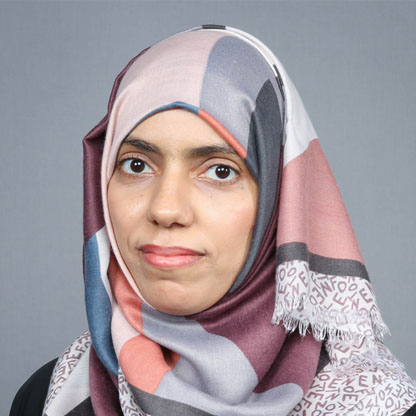
Alaa Ahmad Hussain Farajallah
- Senior Instructor
- Ext: --
Alaa Ahmad Farajallah is a Senior Instructor at College of Pharmacy & Health Sciences at Ajman University with over 15 years of experience in pharmacy education and academic support. She holds a Bachelor of Pharmacy (2005) and an MSc in Clinical Pharmacy (2014) from Ajman University, and is currently pursuing a PhD in clinical pharmacy/pharmacy practice at Universiti Sains Malaysia. Her Master research explored the relationship between the ghrelin hormone and type 2 diabetes among Emirati patients. She has a solid track record in teaching a wide range of tutorials and laboratory courses within the College of Pharmacy and has been an active member of the Clinical Sciences Department’s Training Committee since 2014. In addition to her teaching and research roles, she serves as an Academic Advisor, supporting both newly admitted and continuing students, including those on academic warning or at risk. Her dedication to student success is reflected in her proactive approach to advising, registration assistance, and collaboration with institutional support services. Her research interests include Pharmacy practice; Patient safety; Medication reconciliation and Quality use of medicines
Education
- Master of Clinical Pharmacy, Ajman University, 2014.
- Bachelor of Pharmacy, Ajman University, 2005.
Master of Clinical Pharmacy, Ajman University, 2014.
Bachelor of Pharmacy, Ajman University, 2005.
Experience
- Senior Instructor, Clinical Sciences Department, Ajman University (2022–present)
- Lecturer, Clinical Sciences Department, Ajman University (2016–2022)
- Teaching Assistant, Pharmacology Department (2015–2016)
- Teaching Assistant, Pharmacology Department (2014–2016)
- Part-time Teaching Assistant, College of Pharmacy and Health Sciences, Ajman University of Science and Technology (2006–2014)
Senior Instructor, Clinical Sciences Department, Ajman University (2022–present)
Lecturer, Clinical Sciences Department, Ajman University (2016–2022)
Teaching Assistant, Pharmacology Department (2015–2016)
Teaching Assistant, Pharmacology Department (2014–2016)
Part-time Teaching Assistant, College of Pharmacy and Health Sciences, Ajman University of Science and Technology (2006–2014)
Teaching Area
- Clinical Sciences Department, Training Courses Including: Introductory practice experience I, II, III & Professional practice experience I, II, III, IV, V
- Clinical Sciences department, Training Courses (Hospital and community pharmacy training courses) and Tutorials (Pharmaceutical care-tutorial/ Regulatory affair tutorial)
- Teaching in Various Labs in the Pharmacy College: Pharmacology Lab, Botany Lab, Phytochemistry Lab, Biochemistry Lab, Bioassay Lab, Pharmacognosy Lab
- Delivering Tutorials for Various Courses: Pharmaceutical Care, Pharmacy and Communication Skills, Pharmacy calculation
- Nutrition course
Clinical Sciences Department, Training Courses Including: Introductory practice experience I, II, III & Professional practice experience I, II, III, IV, V
Clinical Sciences department, Training Courses (Hospital and community pharmacy training courses) and Tutorials (Pharmaceutical care-tutorial/ Regulatory affair tutorial)
Teaching in Various Labs in the Pharmacy College: Pharmacology Lab, Botany Lab, Phytochemistry Lab, Biochemistry Lab, Bioassay Lab, Pharmacognosy Lab
Delivering Tutorials for Various Courses: Pharmaceutical Care, Pharmacy and Communication Skills, Pharmacy calculation
Nutrition course
Research
- Pharmacy practice
- Patient safety
- Medication reconciliation
- Quality use of medicine
Pharmacy practice
Patient safety
Medication reconciliation
Quality use of medicine
Publications
-
JournalAl-Tabakha, Moawia M.; Sameer, Farah Tariq; Saeed, Mai Hafiz; Batran, Rahaf Montaser; Abouhegazy, Nada Tarek; Farajallah, Alaa A, Evaluation of bloodletting cupping therapy in the management of hypertension, Journal of Pharmacy and Bioallied Sciences, Mar 2018, doi: 10.4103/jpbs.JPBS_242_17
-
Ghreline and it’s receptors: a review
-
The relationship between ghrelin hormone and type 2 diabetes in a population sample in the UAE
-
Knowledge, believes and behaviors of Ajman university students towards osteoporosis, Research paper, IOSR 2016
-
Awareness level of cancer warning signs and its determinants among university students in UAE, Research paper, Journal of pharmaceutical sciences and research 2018
-
Cancer knowledge and beliefs of non medical students in UAE: A cross sectional study, Research paper, Journal of young pharmacist 2018
-
Calculation the risk factors for developing type2 diabetes among AU staff, Research paper, International research journal of pharmacy 2018
-
Prevalence of dyslipidemia and factors affecting lipid profile in patients with type 2 diabetes, research paper, Diabetes and metabolic syndrome: clinical research and reviews 2019
-
JournalSanah Hasan1,*, , Alaa Faragallah1, Sawsan Deeb Shanableh1 and Sundos Qassim Alebrahem2, Assessing the need for native language in pharmacy education and practice: a survey in the UAE, International Journal of Pharmacy Practice, Dec 2020, doi: doi:10.1093/ijpp/riaa006
-
JournalA national survey on assessment of knowledge, perceptions, practice, and barriers among hospital pharmacists towards medication reconciliation in United Arab Emirates, Scientific reports, Jul 2024
-
JournalDevelopment and feasibility of an educational module on medication reconciliation for hospital pharmacists in the United Arab Emirates: a pilot study, JPHSR, Jul 2023
-
JournalMedication reconciliation practices in Gulf Cooperation Council countries: A review, Journal of Applied Pharmaceutical science, Feb 2024, doi: 10.7324/JAPS.2024.134220
-
JournalPharmacy students’ readiness and preparedness to contribute during disasters: a cross-sectional two institutional study from the UAE, Pharmacy Practice (Granada), Jul 2023
Al-Tabakha, Moawia M.; Sameer, Farah Tariq; Saeed, Mai Hafiz; Batran, Rahaf Montaser; Abouhegazy, Nada Tarek; Farajallah, Alaa A, Evaluation of bloodletting cupping therapy in the management of hypertension, Journal of Pharmacy and Bioallied Sciences, Mar 2018, doi: 10.4103/jpbs.JPBS_242_17
Permissions Original Article Evaluation of Bloodletting Cupping Therapy in the Management of Hypertension Al-Tabakha, Moawia M.; Sameer, Farah Tariq; Saeed, Mai Hafiz; Batran, Rahaf Montaser; Abouhegazy, Nada Tarek; Farajallah, Alaa A.1 Author Information Journal of Pharmacy And Bioallied Sciences 10(1):p 1-6, Jan–Mar 2018. | DOI: 10.4103/jpbs.JPBS_242_17 Open Abstract Background: Bloodletting cupping therapy (Hijama) is a traditional alternative medicine practiced in different cultures. Claims about the therapeutic efficacy of Hijama in hypertension are contradictory. The aim of this project was to determine if Hijama therapy is beneficial in the treatment of patients with hypertension. Materials and Methods: In this retrospective study, 60 files for patients treated for hypertension, aged 40–60 years and whose systolic blood pressure (SBP) is at least 140mm Hg, were used. The data from 30 patient files were obtained from three licensed Hijama centers (study group), whereas data from the rest of 30 patient files were collected from a hospital (control group). The data from Hijama centers included age, date of Hijama therapy, and blood pressure measured before each Hijama session. Both diastolic blood pressure (DBP) and SBP data were obtained over 3-month period. Results: The results showed a significant reduction in SBP (P value < 0.01) over three sessions of wet cupping (from 149.2 to 130.8mm Hg), but this was not significant for DBP over three sessions (P = 0.074). The study also found that the mean SBP in the study group was 9.6mm Hg less than that in the control group (130.8 vs. 140.4mm Hg, P = 0.019), whereas there was no significant difference in DBP between the study group and the control group (87.0 vs. 86.0mm Hg, P = 0.75). Conclusions: Our study shows clear relationship between Hijama and the reduction and control of SBP in patients with hypertension. Therefore, Hijama can be used as an adjunct to conventional therapy, which may allow downtitration of given doses of antihypertensive drugs. The possible association of SBP reduction by Hijama and pain reduction needs an investigation.
About the journal
Ghreline and it’s receptors: a review
The relationship between ghrelin hormone and type 2 diabetes in a population sample in the UAE
Knowledge, believes and behaviors of Ajman university students towards osteoporosis, Research paper, IOSR 2016
Awareness level of cancer warning signs and its determinants among university students in UAE, Research paper, Journal of pharmaceutical sciences and research 2018
Cancer knowledge and beliefs of non medical students in UAE: A cross sectional study, Research paper, Journal of young pharmacist 2018
Calculation the risk factors for developing type2 diabetes among AU staff, Research paper, International research journal of pharmacy 2018
Prevalence of dyslipidemia and factors affecting lipid profile in patients with type 2 diabetes, research paper, Diabetes and metabolic syndrome: clinical research and reviews 2019
Sanah Hasan1,*, , Alaa Faragallah1, Sawsan Deeb Shanableh1 and Sundos Qassim Alebrahem2, Assessing the need for native language in pharmacy education and practice: a survey in the UAE, International Journal of Pharmacy Practice, Dec 2020, doi: doi:10.1093/ijpp/riaa006
Abstract Objectives To evaluate pharmacists’ opinions on the need for Arabic in pharmacy education and practice in the United Arab Emirates (UAE). Methods A questionnaire was developed to address the study objectives and hand delivered to a stratified sample of community pharmacists and a convenience sample of pharmacists in other areas of practice in the UAE. Pharmacists’ responses were measured on a 5-point Likert-type scale (strongly disagree to strongly agree) towards teaching of the following topics in Arabic: management of chronic diseases and minor ailments, screening for diseases and counselling on smoking cessation, exercise, weight management, diet and nutrition and complementary/alternative medicine. Topics related to communication skills were also assessed. Descriptive statistics on participant responses were calculated and chi-square test of independence examined inter-relationships among pharmacist and pharmacy variables. Key findings A total of 351 pharmacists completed the questionnaire. Almost 50% of pharmacists considered Arabic in health sciences education a cultural and/or practice necessity. In pharmacy undergraduate curricula, preferred topics to be taught in Arabic included counselling on complementary/ alternative medicine (67.4%), management of cold/flu (65.5%), counselling on weight management (64.2%), communication in special situations (63.2%), vocabulary (63.2%) and listening and empathic responding (62.6%). For continuing education, topics included management of cold/flu (69.8%) and skin conditions (69.2%), counselling on smoking cessation (68.9%), communicating with physicians and other professionals (54.8%), communication in special situations (54.7%) and vocabulary (50.9%). Conclusions For all assessed topics and communication skills, more than half of the pharmacists agreed that they needed to be included in pharmacy education. A blended learning approach that combines integrated content for native language within an English curriculum could be explored.
About the journal
A national survey on assessment of knowledge, perceptions, practice, and barriers among hospital pharmacists towards medication reconciliation in United Arab Emirates, Scientific reports, Jul 2024
About the journal
Development and feasibility of an educational module on medication reconciliation for hospital pharmacists in the United Arab Emirates: a pilot study, JPHSR, Jul 2023
About the journal
Medication reconciliation practices in Gulf Cooperation Council countries: A review, Journal of Applied Pharmaceutical science, Feb 2024, doi: 10.7324/JAPS.2024.134220
About the journal
Pharmacy students’ readiness and preparedness to contribute during disasters: a cross-sectional two institutional study from the UAE, Pharmacy Practice (Granada), Jul 2023
About the journal
Conference Presentation
- Poster Presentation at DUPHAT 2018: 3D Printing and Its Implementation in the Pharmacy Field.
- Oral and Poster Professional Presentation at DUPHAT 2014: The Relationship Between Ghrelin Hormone and Type 2 Diabetes in the UAE.
- Poster Presentation, International Diabetes Conference, 2014: The Effect of Ghrelin on Diabetes.
- Poster Presentation at the 4th Diabetes Conference: Ghrelin Hormone and Its Effect on Type 2 Diabetes.
- Poster Presentation at DUPHAT 2018: Disease to be Different: Eidetic Imaginary Disease in Children.
- Poster Presentation at DUPHAT 2018: The Risk Calculation of Type 2 Diabetes Among Ajman University Staff.
- Poster Presentation at DUPHAT 2017: The Need for Language Skill Learning in the Pharmacy Curriculum.
- Poster Presentation at the 11th Medication Safety Conference 2018: Language Competence – Development of Arabic Content for the Pharmacy Curriculum.
- ICPM Poster and Oral Presentation: GCC Practice of Medication Reconciliation, 2021.
- Poster presentation at Qatar University: Pharmacy education, Science, and Practice Conference 2025. Quantitative and qualitative assessments of medication reconciliation module for hospital pharmacists in the United Arab Emirates: lessons learned
- 2025 ACCP virtual poster symposium: poster presentation on "Clinical Pharmacist-Led Medication Reconciliation Interventions: Four Case Reports"
- International conference of Pharmacy & Medicine (2024): Oral speaker on "Qualitative impact assessment of a medication reconciliation module among hospital pharmacy practitioners in the United Arab Emirates"
- The 3rd International Conference on Pharmaceutical Sciences and Military Pharmacy (ICOPMAP) (2023) poster presentation on "Pilot testing of an educational module on medication reconciliation for hospital pharmacists in UAE
- Professional Poster Presentation at DUPHAT 2024
Poster Presentation at DUPHAT 2018: 3D Printing and Its Implementation in the Pharmacy Field.
Oral and Poster Professional Presentation at DUPHAT 2014: The Relationship Between Ghrelin Hormone and Type 2 Diabetes in the UAE.
Poster Presentation, International Diabetes Conference, 2014: The Effect of Ghrelin on Diabetes.
Poster Presentation at the 4th Diabetes Conference: Ghrelin Hormone and Its Effect on Type 2 Diabetes.
Poster Presentation at DUPHAT 2018: Disease to be Different: Eidetic Imaginary Disease in Children.
Poster Presentation at DUPHAT 2018: The Risk Calculation of Type 2 Diabetes Among Ajman University Staff.
Poster Presentation at DUPHAT 2017: The Need for Language Skill Learning in the Pharmacy Curriculum.
Poster Presentation at the 11th Medication Safety Conference 2018: Language Competence – Development of Arabic Content for the Pharmacy Curriculum.
ICPM Poster and Oral Presentation: GCC Practice of Medication Reconciliation, 2021.
Poster presentation at Qatar University: Pharmacy education, Science, and Practice Conference 2025. Quantitative and qualitative assessments of medication reconciliation module for hospital pharmacists in the United Arab Emirates: lessons learned
2025 ACCP virtual poster symposium: poster presentation on "Clinical Pharmacist-Led Medication Reconciliation Interventions: Four Case Reports"
International conference of Pharmacy & Medicine (2024): Oral speaker on "Qualitative impact assessment of a medication reconciliation module among hospital pharmacy practitioners in the United Arab Emirates"
The 3rd International Conference on Pharmaceutical Sciences and Military Pharmacy (ICOPMAP) (2023) poster presentation on "Pilot testing of an educational module on medication reconciliation for hospital pharmacists in UAE
Professional Poster Presentation at DUPHAT 2024
Memberships, Awards and Honors
- Award for Excellence with Honors in Master's Degree Graduation, Ajman University, 2014.
- Award for Excellence with Honors in Bachelor's Degree Graduation, Ajman University, 2005.
- AU Chancellor's Award for Active Participation in AU Dinner, 2017.
- 1st winner for Oral Presenter in 3rd ICOPMAP 2023
- Member in Emirates medical association, Emirates pharmacy Society
- Member in UAE Red Crescent