Ajman University showcases its e-learning experience to Arab Universities

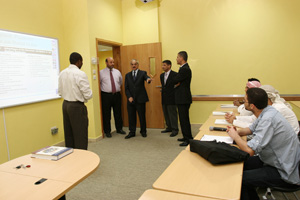
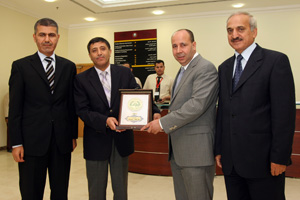
Ajman University of Science & Technology (AUST) has hosted a conference on e-learning with the Association of Arab Private Institutions of Higher Education. Visiting delegates included Dr. Nasr Saleh Khaled Al-Zubaide, Head of the Executive Office of the Association and the President of Al Zaytoonah University, Jordon, and Dr. Taleb Al Saree, Secretary-General of the Association and Director of the Arab Open University in Jordon. Attending the welcome session were AUST Vice Presidents Dr. Ahmed Ankit and Dr. Basheer Shehadeh, as well as deans, and heads of department. The events included a workshop on the experience of e-learning using the "Moodle" system at AUST and the Arab Open University. Dr. Basheer Shehadeh, AUST Vice President for Follow-up and Development, said that the University has since its inception striven to utilize the latest technology in teaching methods, and exchange expertise and experience with peer higher education institutions. He valued the experience of the Arab Open University in applying e-learning in all its campuses during its eight years of coordination with the British Open University.
Dr. Ahmed Ankit, AUST Vice President for External Relations and Cultural Affairs, said that H.E. Dr. Saeed Salman, AUST Supreme President, called early to adopt open learning in universities. He added that AUST is currently teaching 40 percent of its courses through e-learning using Moodle, and that teaching in all AUST colleges will become fully electronic by 2011. After providing infrastructure, including well equipped classrooms, smart boards, closed television circuits and virtual interactive tools in its two campuses at Ajman and Fujairah, AUST will to train faculty members to use e-learning and to monitor students interaction and satisfaction levels. A further AUST goal is to enable faculty members to obtain "Moodle Certificate. "
Dr. Taleb Al Saree stated that the Arab Open University has succeeded in applying the e-learning system at all its campuses abroad, and 3,000 students have graduated and 30,000 enrolled who have interacted effectively with faculty members via e-learning. Dr. Taleb added that the University has imposed strict quality standards relating to program learning outcomes, for example by limiting the number of students to each faculty member to between 20 and 25, and requiring success in continuous assessment. At the same time, it has been flexible in dealing with students class hours, which include Saturdays, and in allowing all ages to register. Moreover, the Arab Open University s teaching system is different in that it ensures that students assume responsibility for their own learning, and also accustoms them to being proactive and participative. One good indicator of this is that about 75 percent of the Arab Open University female students are housewives who have not hitherto had the opportunity to study at university because of early marriage or other circumstances. Furthermore, the cost of higher education in the Arab world is continually increasing and the methods and means of teaching are also under constant development. Dr. Al Saree concluded by stating that the motto of the Arab Open University is to provide learning for all and from everywhere.
Dr. Al-Aubaide said that the latest news from Al Zaytoonah University is the accreditation of two new programs that are the first of their kind in Arab universities. They are the Bachelor of Infrastructure and Civil Engineering, and the Bachelor of Computer and Communication Engineering. He added that the College of Nursing, which has more than 800 students, is the university s great success story.
Dr. Taleb said that the Arab Open University will open two new campuses in Yemen and Egypt. The expansion plan in the Arab world has taken into account the individual culture and characteristics of each country, as well as time differences. After discussing the technical challenges that e-learning may face, Dr. Taleb expressed the readiness of the Arab Open University for unlimited cooperation with AUST, commenting that AUST s equipment and infrastructure will enable it to successfully complete the implementation of e-learning.
Dr. Ahmed Al-Dabbagh, Director of Academic e-Services at AUST, presented the University s experience in applying the e-learning system. The University has remained dedicated to the Moodle system, promoting it both internally and externally via workshops for schools and other institutions in Dubai and the northern emirates. He said that six AUST colleges at Ajman and Fujairah are currently applying e-learning using Moodle. He concluded his presentation by saying that a student survey revealed very high levels of satisfaction with Moodle, which has encouraged AUST to expand its use to the remaining colleges.