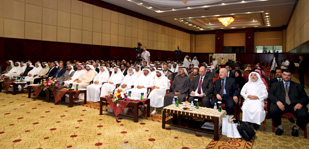
Ajman University Organizes an Approach Seminar on Volunteer Work

On the occasion of the 10th anniversary of the international year of volunteers, and under the patronage of His Highness Sheikh Humaid Bin Rashid Al Nuaimi, Member of the Supreme Council, Ruler of Ajman, Ajman University of Science and Technology organized an approach seminar on Volunteer Work and its Role in Development, at Sheikh Zayed Centre for Conferences and Exhibitions. The Seminar was chaired by H. E. Dr. Saeed Salman, AUST President, with the participation of H.E. Saeed Al Raqabani, Advisor to H.H. Sheikh Hamad Bin Mohamed Sharqi, Member of the Supreme Council Ruler of Fujairah and Chairman of the Board of Directors of the Fujairah Charity Association; Dr. Kamel Idriss, former director general of the World Intellectual Property Organization; Dr. Sameer Kassem Fakhrou, consultant at Wafaa Group for Capacity Building and the Development of the Palestinian People. The event was attended by AUST vice presidents, deans, and faculty members, besides a number of academicians, experts and professionals as well as journalists and charitable organizations from the UAE and other countries.
Several accompanying activities were held on the sidelines of the seminar, that attracted many charitable and social organizations, which included among other things an exhibition of publications on volunteer work and charity and volunteer organizations operating in Ajman and the UAE.
In his speech, Dr. Saeed Salman said that the motive behind this reunion is to highlight the importance of volunteer work and its role in developing the individuals, building their professional and financial capacities, coordinating volunteer activities between AUST and other institutions, and putting forward the volunteer efforts exerted by AUST different academic and administrative units, namely AUST Alumni Association, the Training and Employment Agency, the College of Dentistry and the Deanship of Student Affairs. AUST president said: "When we talk about the University of the future, we conclude that it evolves around three dimensions: education, information and investment. We should therefore take the university out of its conventional concept and make the university a place that educates, trains and coaches. We are not going to exaggerate and say that we implement our vision 100%, but we are evolving, and our friends and colleagues will assist us in attaining our objectives." He also stressed out the importance of investing the existing intellectual capital in education and training, adding that "our words remain words until they are turned into applied practices."
Dr. Saeed Salman's intervention was followed by H.E. Saeed Raqabani's who applauded the efforts exerted by AUST president in raising public awareness and supporting the initiatives of volunteer and charitable work. He then addressed the role of voluntarism in development, pointing out that it impacts positively the individual, the family and the community, adding that it also consolidates social solidarity, and instills social values. "Charitable and volunteer work in the UAE is not something new. The late Sheikh Zayed placed great importance on this type of work, setting up the appropriatse legislation and institutions, securing to the UAE a leading role in voluntarism in the region."
Dr. Kamel Idriss, WIPO former director general, said that the way to sustainable and comprehensive development must go through training and skills development, noting that charity and voluntarism actors should be given the necessary incentives in order not to remain marginalized. "If we want to invest on human energies we have to cater for the regulatory aspect as it is the cornerstone for any organization's success or failure." He further stressed the concepts of transparency, assessment and adjustment as vital elements for any development effort.
Then Dr. Sameer Fakhrou, from Wafaa Group for Capacity Building, discussed the human element in sustainable development, describing it as the living fuel of development. He also detailed how failures could be turned into successes, and how rivals could become friends. Dr. Fakhrou pointed out to the close link between the mind and the heart. He also stressed out the noble values charitable and volunteer work inculcates on people. "Clean souls are the living fuel of development. Any character building effort must be based on high morals." He added.
Also from Wafaa Group was Dr. Abdulaziz Hariz who talked about the importance of innovation in voluntarism. Dr. Hariz displayed examples applied by Wafaa Group to support the Palestinian people living in the occupied territories and elsewhere, through loans and grants aimed at achieving self-reliance through small projects that can create jobs, generate incomes and offer schooling for the Palestinian people.
From the UAE Volunteers Association, Mr. Ali Abdullah Dabani discussed the development of charitable and volunteer work in the UAE, giving concrete examples of the commitment of the UAE people to voluntarism which is largely triggered by the local religious and social values, and proposed ways for increasing further awareness of the UAE population on volunteer work.
In the intervention of Mr. Ihab Dawood Al Muhtasib, he addressed how the internet and IT solutions can be applied in implementing charity projects. He further explained how online sites can establish strong communication bridges with donors and beneficiaries, by detailing all the required information about lending, criteria for donors, existing and undergoing projects, and eligibility conditions for beneficiaries.
Dr. Anas Tekriti, an AUST early graduate, concluded the seminar by extending his appreciation to Ajman University. He then talked about how dreams can be turned into reality. "It has been 18 years now since I left AUST, I was really surprised to see that the dreams of Dr. Salman have come true, thanks to his determination and hard work." He then gave a comparison between voluntarism in the UK, where he is living now and between his native country. He concluded that in Britain there is no one individual who does not contribute, whereas in Arab countries voluntarism is still concentrated on few people, few institutions and few fields. "The difference is how deep we are aware of voluntarism. That is why we should clarify concepts and plan a new awareness that will trigger our involvement." he said.
During the seminar some short documentary films on Ajman University were displayed to reflect the role and activities the University carried out in the field of voluntarism and charitable work. After the interventions, room was open for debate between the audience and the panel.