Ajman University Researchers Lead New Global Reference on Structural Biology
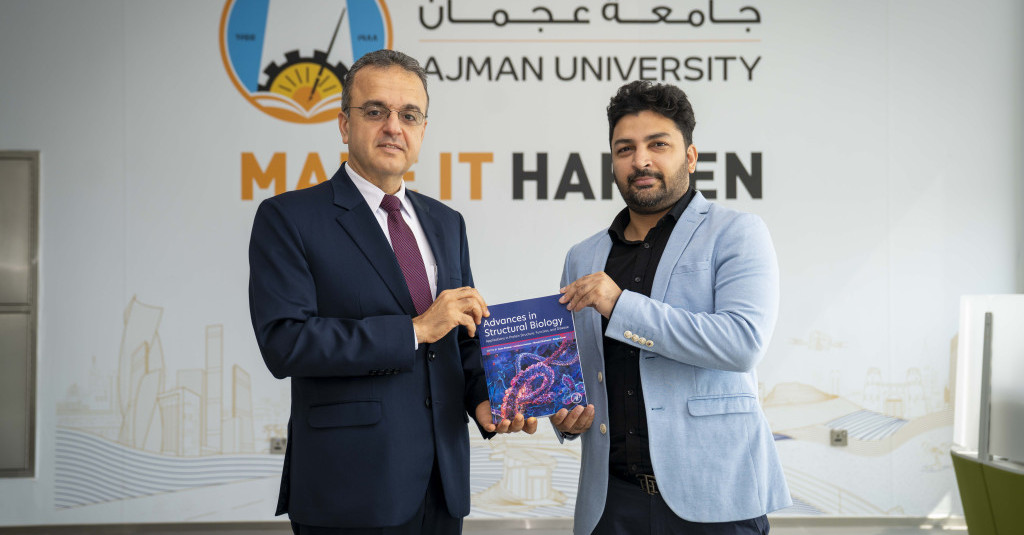
Ajman University's Dr. Mohammad Anas Shamsi leads an international team of authors in a new Elsevier volume linking protein science to the search for better treatments for cancer and neurodegenerative disease.
Every disease has a structure behind it. Before a new treatment can reach a patient, researchers need to understand how proteins fold, move, and malfunction, and how those small changes drive conditions as serious as cancer and neurodegenerative disease.
A new book led by Ajman University (AU) researchers is helping bring that work into sharper focus. “Advances in Structural Biology: Applications in Protein Structure, Function, and Disease,” published by Academic Press, an imprint of the internationally recognized scientific publisher Elsevier, is edited by Dr. Mohammad Anas Shamsi, Research Assistant Professor at AU's Center of Medical and Bio-allied Health Sciences Research. Professor Moyad Shahwan, Head of the Center, joins him as one of the book's co-editors.
The volume brings together the field's most powerful tools: studies of protein structure, folding, and dynamics, alongside experimental techniques, computational modeling, and artificial intelligence. What sets it apart is where it points those tools. Each approach is connected to a practical goal, from understanding how diseases work at the molecular level to opening new paths for drug discovery.
The book draws on contributing authors from institutions in eight countries: the UAE, India, the United States, China, Russia, South Korea, Kuwait, and Türkiye. With AU at the editorial helm, it brings international perspectives into one shared conversation about where structural biology is heading next.
Designed for researchers, educators, and postgraduate students, the book offers a single, comprehensive resource that links fundamental protein science with emerging biomedical applications. For a graduate student taking their first steps in the lab or an established scientist exploring AI-driven methods, it serves as a bridge between core knowledge and the breakthroughs still to come.
The questions shaping the future of cancer and neurodegenerative disease research are being taken up right here at AU, by faculty who are helping define the field on a global stage. That expertise doesn't stay on the page. It flows into AU's labs and classrooms, giving students the chance to learn from and work alongside researchers whose work reaches far beyond the university's walls.
Dr. Shamsi's work reflects AU's commitment to research excellence, international collaboration, and knowledge exchange, and to research that moves science closer to the patients who need it most.