AU Students Debut AI-Powered Marine Surveillance System at Dubai Environment Conference & Exhibition 2026
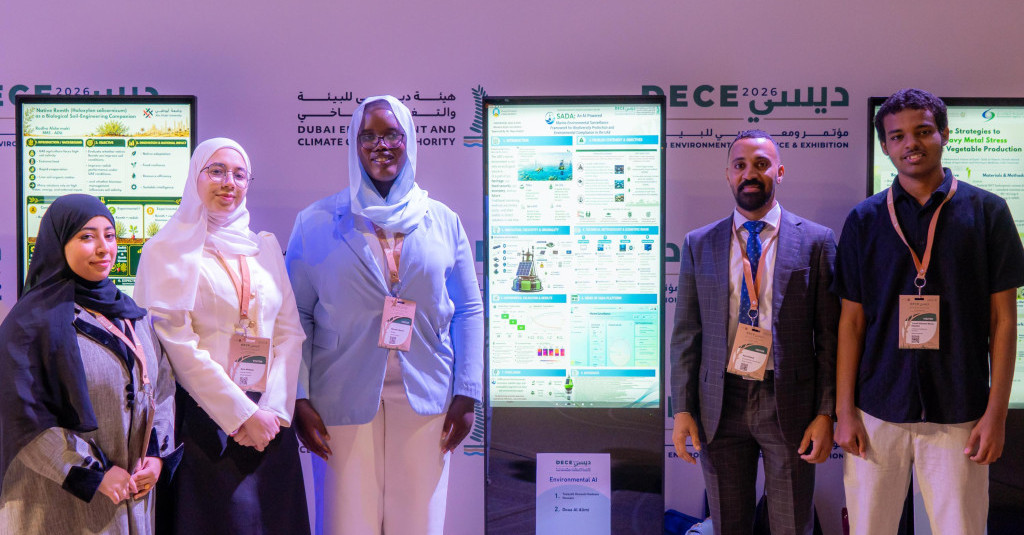
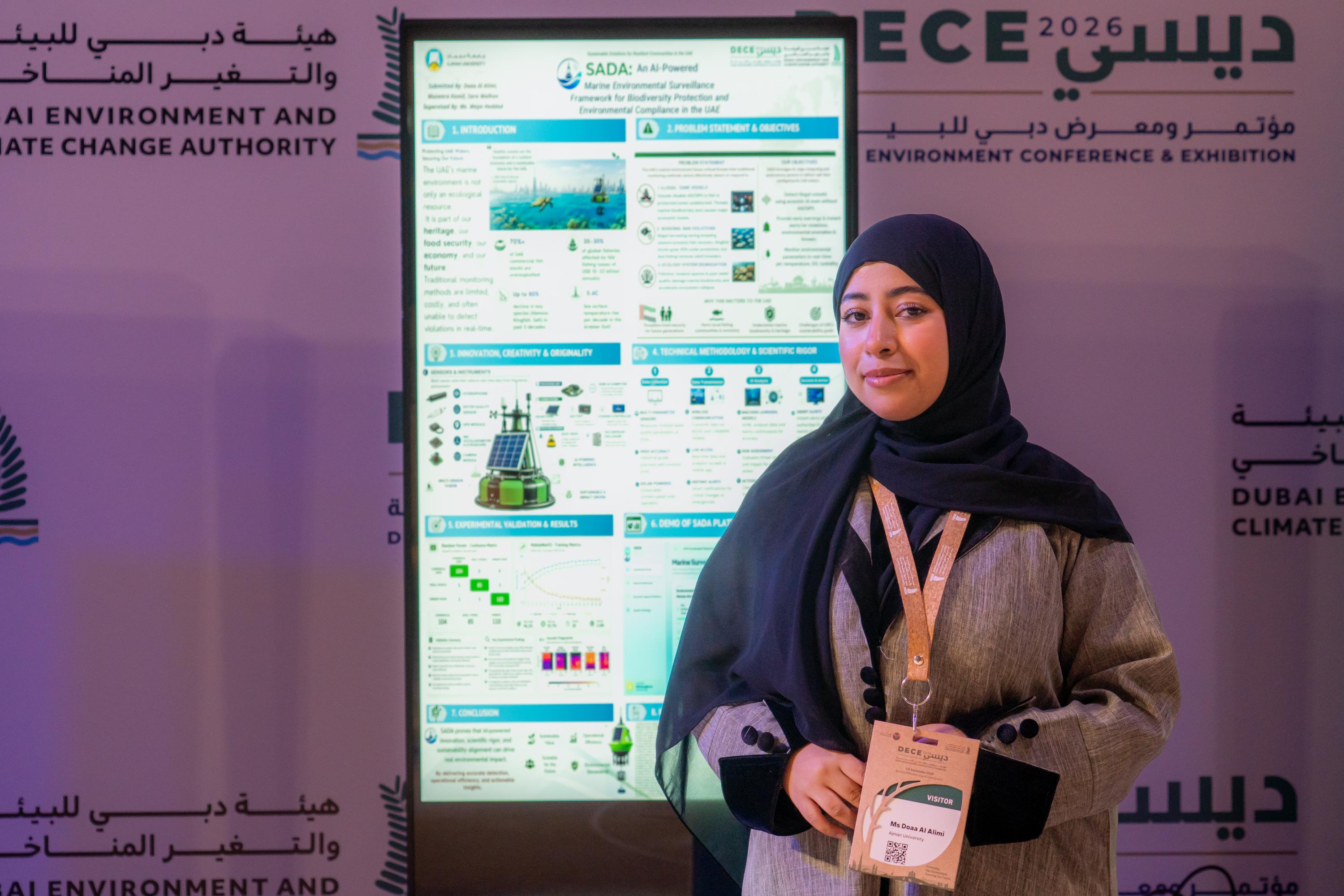
Ajman University students presented SADA at DECE 2026, an AI-driven marine monitoring solution that detects illegal fishing activities and environmental risks using passive acoustic and water quality sensing to help protect the UAE’s marine ecosystems and Blue Economy
Out at sea, a fishing boat can vanish from every tracking screen with the flip of a switch. Three Ajman University (AU) students set out to find it anyway. At the inaugural Dubai Environment Conference & Exhibition (DECE) 2026, Doaa Al Alaimi, Muneera Kamil, and Sarah Walhan presented “SADA: An AI-Powered Marine Environmental Surveillance Framework for Biodiversity Protection and Environmental Compliance in the UAE,” supervised by Maya Haddad, Senior Sustainability Manager at AU, and Rami Elhadi, Administrative Coordinator in AU’s Office of Sustainability.
Hosted by the Dubai Environment and Climate Change Authority (DECCA) under the slogan “Protecting Our Environment, Securing Our Future,” the two-day event centered on Dubai’s climate resilience goals, goals AU encourages its students to pursue through their academic work.
Many of the UAE’s commercial fish stocks are overexploited, with key species such as Hamour, Kingfish, and Safi experiencing significant declines over the past three decades. Part of the problem is boats that go dark, switching off their GPS and AIS, the system that broadcasts a ship’s identity and position to authorities, so they can fish in protected zones unseen. Others fish during seasonal breeding bans. Conventional monitoring is slow and costly, and it usually catches violations only after the damage is done.
SADA uses solar-powered buoys that keep watch over UAE waters day and night. Each carries cameras, GPS, water quality sensors, and hydrophones, which are underwater microphones. Because every vessel makes its own underwater sound, or acoustic signature, onboard AI can detect boats even after their tracking signals are off. The sensors also measure pH (acidity), temperature, dissolved oxygen (the oxygen marine life breathes), and turbidity (cloudiness), flagging early signs of pollution before they spread.
Data travels to shore over 4G/5G or LoRaWAN, a low-power network that sends small amounts of data over long distances, and reaches a web and mobile platform that alerts authorities as soon as a possible violation is detected. Using two machine learning models, Random Forest and MobileNetV2, to tell vessel sounds apart from ordinary ocean noise, the team took SADA from idea to working prototype.
For the students, the message is simple: technology built on sound science can make a real difference, and healthy marine ecosystem are the foundation of a resilient economy and sustainable future that aligns with the UAE’s Year of Sustainability and the national biodiversity strategy. For AU, SADA shows research-led learning in practice, with students taking on a national challenge and presenting their work alongside professionals and policymakers.